Use this A2-B1 ESL science reading passage to learn how a clock works. It includes key vocabulary, reading comprehension questions, and answers for English learners.

Reading Level
A2-B1
Word Count
235 words
Reading Passage
A clock is a tool that shows time. It helps people know when to wake up, go to school, eat, work, or sleep.
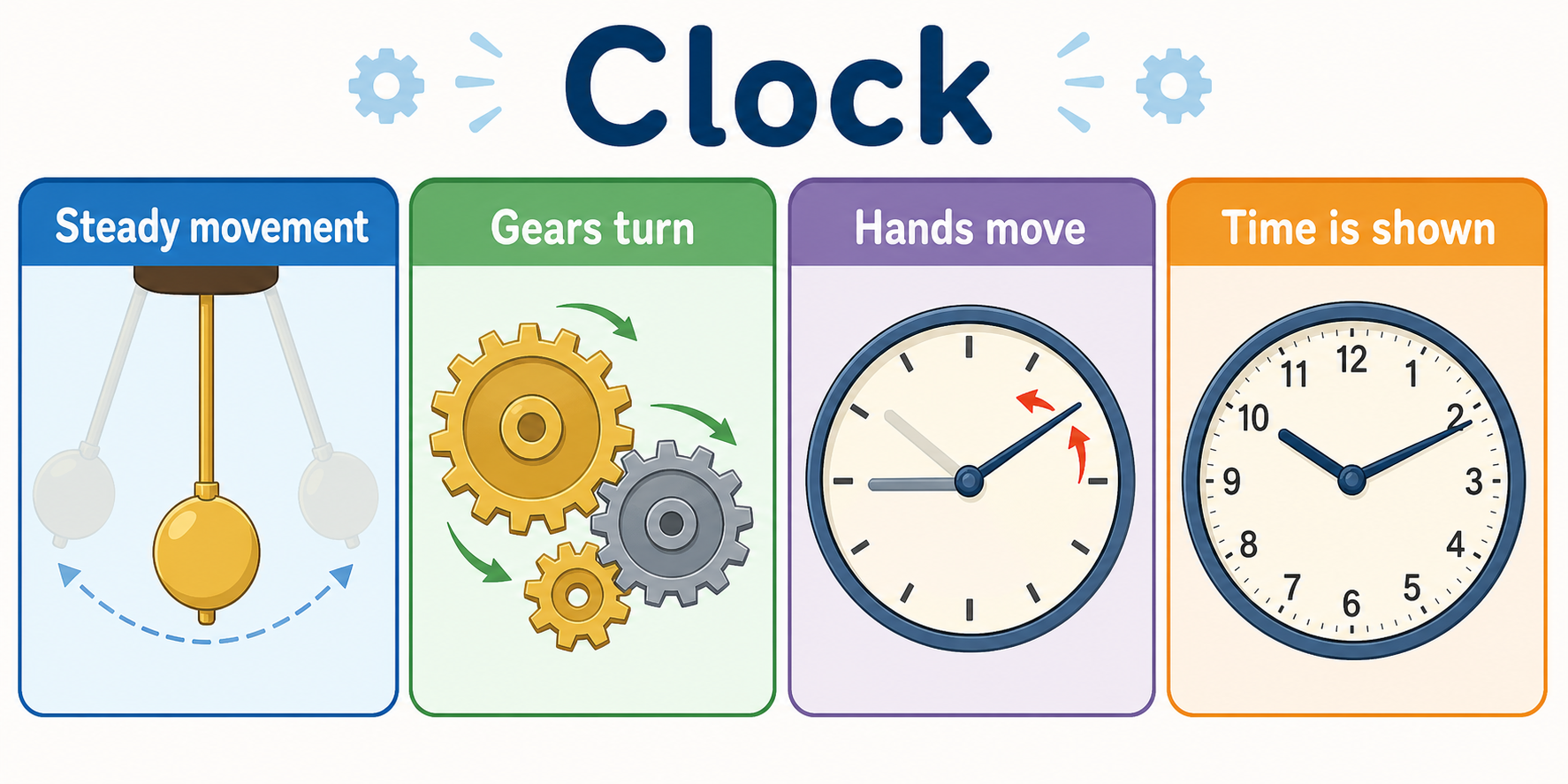
A clock must measure time in a regular way. Many clocks do this by counting steady movements. If the movement is always the same, the clock can count seconds, minutes, and hours.
Old mechanical clocks use moving parts. Inside them, a gear turns other gears. The gears control the speed of the clock. They also move the clock hands.
On a clock face, each hand has a job. The short hand shows the hour. The longer hand shows the minute. Some clocks have a thin hand that shows each second.
Digital clocks work differently. They use electronic parts to count time. Many digital clocks use a tiny crystal that moves in a very steady way when electricity passes through it.
No matter the type, a clock needs a steady pattern. The pattern may come from gears, a swinging pendulum, or electronic signals.
Clocks work by counting regular movement and showing the count as time. This helps people organize each day.
Key Vocabulary
| Word | Meaning | Example |
|---|---|---|
| clock | a tool that shows time | The clock says it is eight o'clock. |
| measure | to find the size, amount, or length of something | A clock measures time. |
| gear | a wheel with teeth that turns other parts | A gear can turn another gear. |
| hand | a pointer on a clock face | The short hand shows the hour. |
| second | a small unit of time | Sixty seconds make one minute. |
Reading Comprehension Questions
- What does a clock show?
- Why does a clock need regular movement?
- What do gears do in a mechanical clock?
- What does the short hand show?
- How do many digital clocks count time?
Answers
- A clock shows time.
- It needs regular movement to count time correctly.
- Gears turn other gears and move the clock hands.
- The short hand shows the hour.
- They use electronic parts and a tiny crystal.
Short Summary
A clock works by counting regular movement. Mechanical clocks use gears and hands, while digital clocks use electronic signals.
More Easy Readings
'Everyday Science' 카테고리의 다른 글
| Why Do Boats Float? | A2 ESL Science Reading Passage (0) | 2026.07.05 |
|---|---|
| How Does a Bicycle Work? | A2 ESL Science Reading Passage (0) | 2026.07.05 |
| How Does a Camera Work? | A2 ESL Science Reading Passage (0) | 2026.06.28 |
| How Does a Refrigerator Work? | A2 ESL Science Reading Passage (0) | 2026.06.27 |
| Why Do Batteries Run Out? | A2 ESL Science Reading Passage (0) | 2026.06.19 |