Use this A2-B1 ESL science reading passage to learn why people have fingerprints. It includes key vocabulary, reading comprehension questions, and answers for English learners.
Read the passageTry the questions
Reading Level
A2-B1
Word Count
207 words
Reading Passage
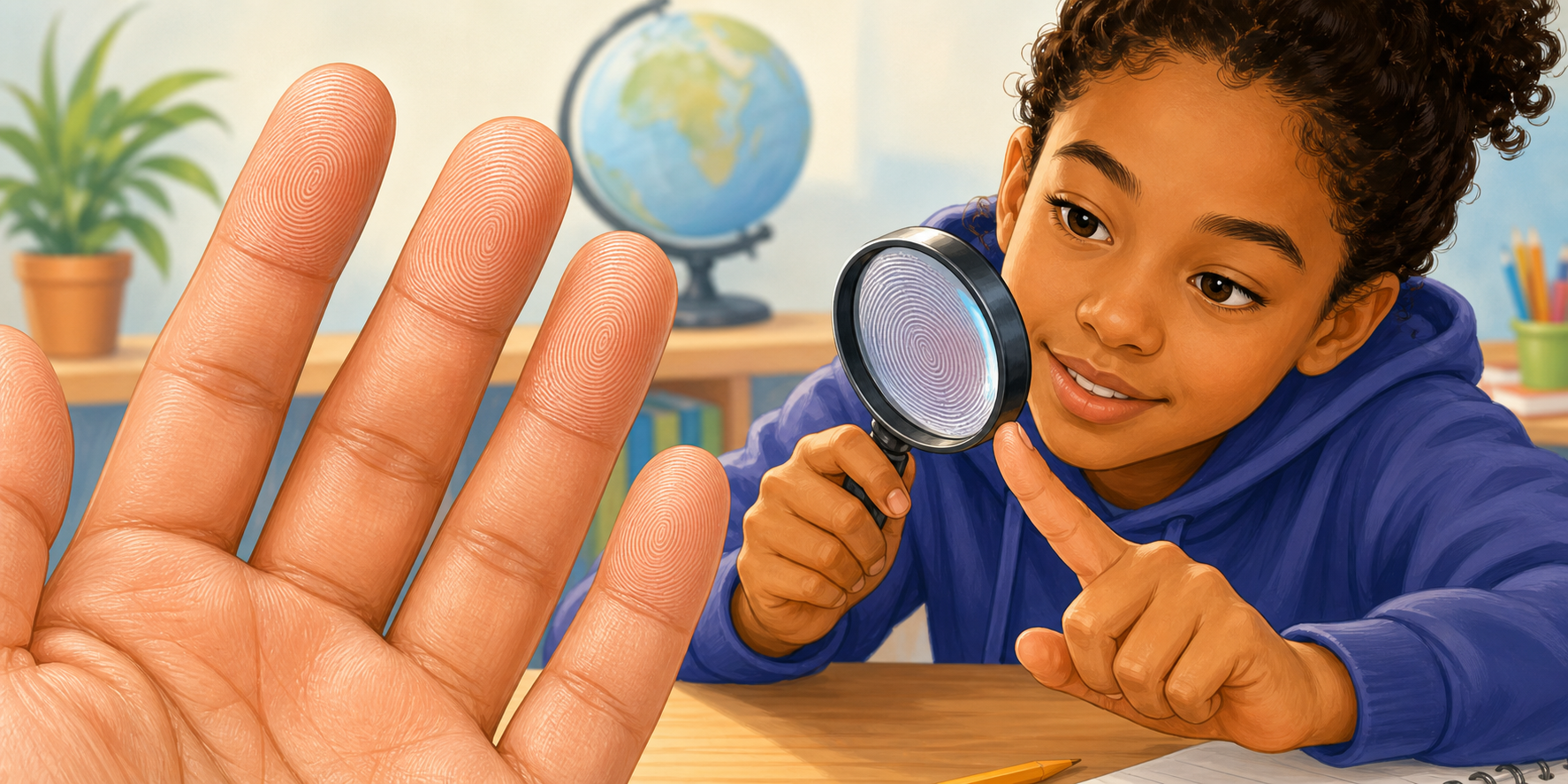
Look closely at the tips of your fingers. You can see many small lines. These lines make your fingerprint.
Fingerprints are not just marks on the skin. They help your fingers touch and hold things. The tiny lines make the skin less smooth. This can help you grip objects like a pencil, a cup, or a phone.
Fingerprints may also help us feel small details. When your finger moves across a surface, the lines on your skin help send information to your nerves. This helps your brain understand what you are touching.
Every person has a different fingerprint pattern. Some patterns look like loops. Some look like waves or circles. Even twins do not have exactly the same fingerprints.
This makes fingerprints unique. A person's fingerprints can be used to help identify them. Fingerprints can also leave marks on glass, paper, or metal because our skin has natural oils.
Fingerprints begin to form before a baby is born. They stay mostly the same during a person's life. Cuts can change the skin for a short time, but the main pattern often comes back.
Fingerprints are small, but they are useful. They help us hold things, feel the world, and show that every person is a little different.

Key Vocabulary
| Word | Meaning and example |
|---|---|
| fingerprint | the pattern of lines on the skin of a finger My fingerprint has many small lines. |
| pattern | a repeated shape or design Each finger has a special pattern. |
| grip | to hold something firmly Fingerprints help us grip a cup. |
| surface | the outside or top part of something The table has a smooth surface. |
| unique | different from all others Your fingerprint is unique. |
Reading Questions
- Where can you see fingerprints?
- How can fingerprints help us hold things?
- What do fingerprints help the brain understand?
- Do twins have exactly the same fingerprints?
- When do fingerprints begin to form?
Answers
- You can see fingerprints on the tips of your fingers.
- The tiny lines make the skin less smooth and help us grip.
- They help the brain understand what we are touching.
- No, twins do not have exactly the same fingerprints.
- They begin to form before a baby is born.
Short Summary
Fingerprints are tiny line patterns on our fingers. They help us grip, feel surfaces, and identify each person.
More Easy Readings
'Human Body' 카테고리의 다른 글
| Why Do We Have Tears? | A2 ESL Science Reading Passage (0) | 2026.09.21 |
|---|---|
| Why Do We Have Eyebrows? | A2 ESL Science Reading Passage (0) | 2026.07.04 |
| How Do Bones Heal? | A2 ESL Science Reading Passage (0) | 2026.07.03 |
| Why Do We Have Nails? | A2 ESL Science Reading Passage (0) | 2026.06.28 |
| Why Do We Shiver? | A2 ESL Science Reading Passage (0) | 2026.06.23 |