Use this A2-B1 ESL science reading passage to learn about the northern lights. It includes key vocabulary, reading comprehension questions, and answers for English learners.
Reading Level
A2-B1
Word Count
275 words
Reading Passage
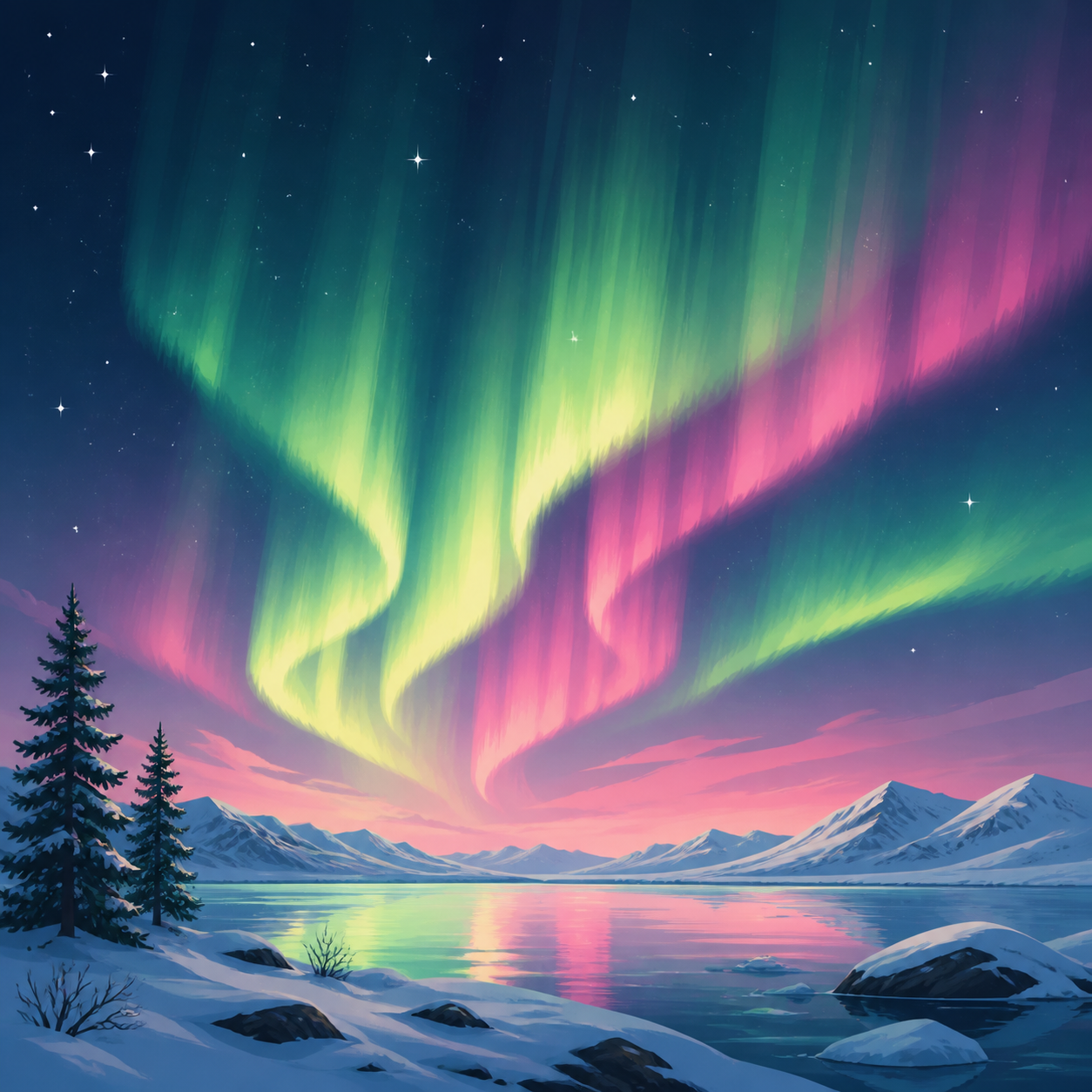
The Northern Lights are colorful lights that appear in the night sky near the North Pole. They can look green, pink, purple, or blue. Their scientific name is aurora borealis.
The Northern Lights begin with the sun. The sun sends tiny charged particles into space. Sometimes these particles travel toward Earth.
Earth has a magnetic field around it. This magnetic field helps protect our planet. It also guides some particles toward the polar areas. When the particles reach Earth's upper atmosphere, they meet gases such as oxygen and nitrogen.
When the particles hit these gases, energy is released as light. Different gases can make different colors. Oxygen often makes green or red light. Nitrogen can make blue or purple light.
People usually see the Northern Lights in cold northern places such as Alaska, Canada, Norway, Iceland, and Finland. There are also Southern Lights near the South Pole. Their scientific name is aurora australis.
Long ago, many people made stories about the Northern Lights because they looked mysterious. Today, scientists understand more about them, but they still feel amazing to watch.

Key Vocabulary
| Word | Meaning | Example |
|---|---|---|
| aurora borealis | colorful natural lights seen near the North Pole | The aurora borealis can glow green. |
| particles | very small pieces of matter | Particles from the sun travel through space. |
| magnetic field | an invisible area of force around Earth | Earth's magnetic field helps guide particles. |
| atmosphere | the layer of gases around Earth | The lights happen in the upper atmosphere. |
| polar | near the North Pole or South Pole | Auroras are often seen in polar areas. |
Reading Comprehension Questions
- Where are the Northern Lights usually seen?
- What sends charged particles into space?
- What helps guide particles toward polar areas?
- What gases can help make aurora colors?
- What are the Southern Lights called?
Answers
- They are usually seen near the North Pole.
- The sun sends charged particles into space.
- Earth's magnetic field helps guide the particles.
- Oxygen and nitrogen can help make aurora colors.
- They are called aurora australis.
Short Summary
The Northern Lights happen when particles from the sun meet gases in Earth's upper atmosphere. This creates colorful lights near the polar areas.
More Easy Readings
'Space and Earth' 카테고리의 다른 글
| Why Do Shadows Change During the Day? | A2 ESL Science Reading Passage (0) | 2026.06.16 |
|---|---|
| Why Does the Moon Change Shape? | A2 ESL Science Reading Passage (0) | 2026.05.31 |
| Why Do Volcanoes Erupt? | A2 ESL Science Reading Passage (0) | 2026.05.30 |
| Why Is the Ocean Salty? | A2 ESL Science Reading Passage (0) | 2026.05.29 |
| Why Is the Sky Blue? | A2 ESL Science Reading Passage (0) | 2026.05.23 |