Use this A2-B1 ESL science reading passage to learn how magnets work. It includes key vocabulary, reading comprehension questions, and answers for English learners.

Reading Level
A2-B1
Word Count
196 words
Reading Passage
Magnets are objects that can pull some metals toward them. They can also push away other magnets. This invisible pulling and pushing force is called magnetism.
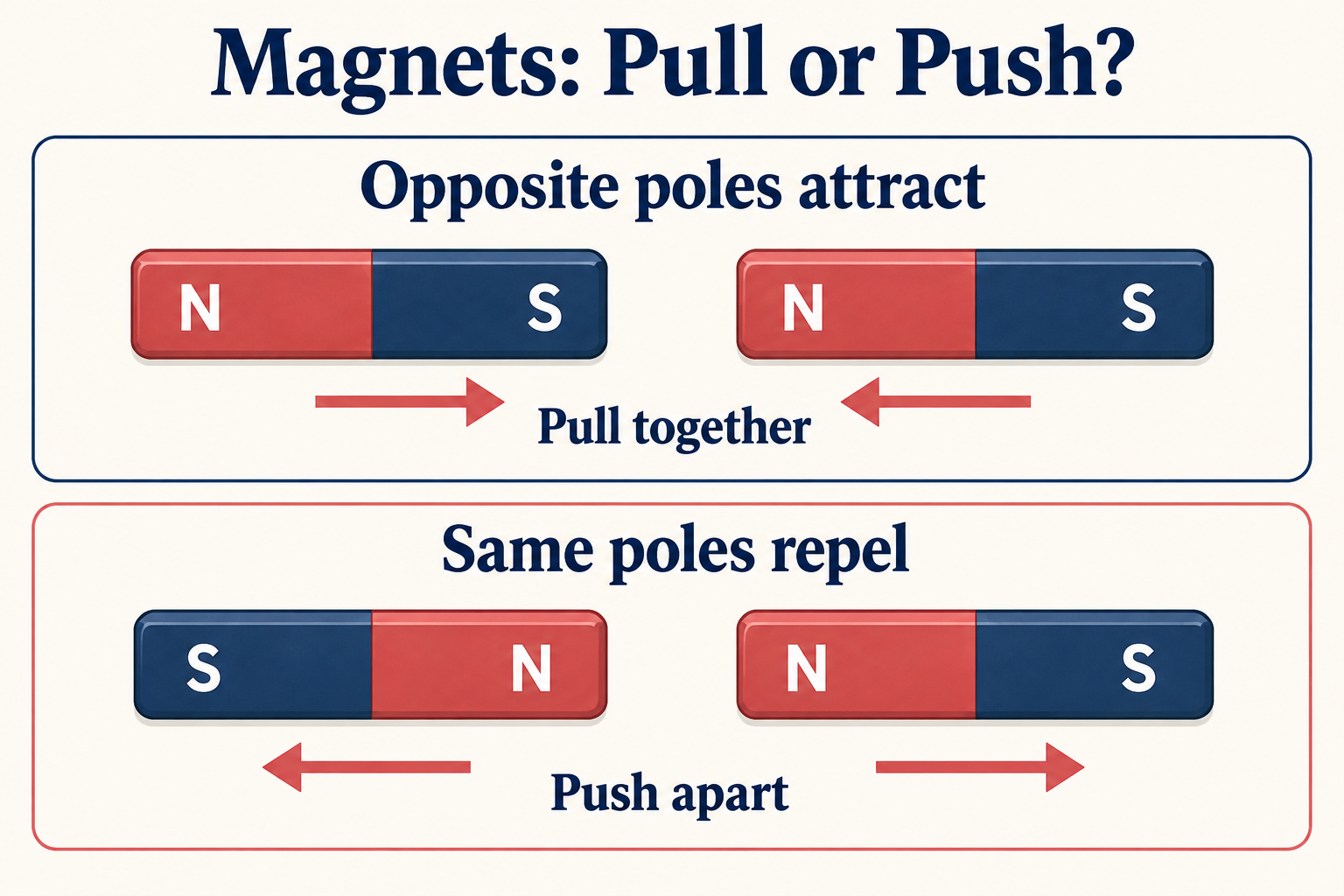
A bar magnet has two ends. These ends are called poles. One end is the north pole, and the other end is the south pole. Opposite poles pull together. A north pole and a south pole attract each other. The same poles push away from each other.
Magnets can attract metals such as iron, nickel, and cobalt. They do not attract every metal. For example, many magnets do not pull strongly on aluminum or copper.
The area around a magnet where its force can work is called a magnetic field. You cannot see this field with your eyes, but you can see its effect. If you put iron filings near a magnet, they form lines that show the shape of the magnetic field.
Magnets are useful in everyday life. They are inside speakers, phones, computers, motors, and refrigerator doors. A compass also uses a magnet. A compass needle lines up with Earth's magnetic field and points roughly north.
Magnets may seem simple, but they help many machines and tools work.
Key Vocabulary
| Word | Meaning | Example |
|---|---|---|
| magnetism | the force that makes magnets pull or push | Magnetism can pull iron toward a magnet. |
| poles | the two ends of a bar magnet | A bar magnet has a north pole and a south pole. |
| attract | to pull something closer | Opposite poles attract. |
| magnetic field | the invisible area of force around a magnet | A magnetic field surrounds a magnet. |
| compass | a tool that uses a magnet to show direction | A compass needle points roughly north. |
Reading Comprehension Questions
- What is magnetism?
- What are the two ends of a bar magnet called?
- What happens when opposite poles meet?
- What metals can magnets attract?
- Why does a compass needle point roughly north?
Answers
- Magnetism is the force that makes magnets pull or push.
- The two ends are called poles.
- Opposite poles attract each other.
- Magnets can attract metals such as iron, nickel, and cobalt.
- It lines up with Earth's magnetic field.
Short Summary
Magnets work through magnetism, an invisible force that can attract some metals and push or pull other magnets.
Science Sources
More Easy Readings
'Everyday Science' 카테고리의 다른 글
| Why Does Metal Rust? | A2 ESL Science Reading Passage (1) | 2026.06.13 |
|---|---|
| How Does Soap Clean? | A2 ESL Science Reading Passage (0) | 2026.06.12 |
| How Does a Compass Work? | A2 ESL Science Reading Passage (0) | 2026.06.10 |
| How Do Plants Drink Water? | A2 ESL Science Reading Passage (0) | 2026.05.28 |
| How Do Airplanes Fly? | A2 ESL Science Reading Passage (0) | 2026.05.28 |