This short science reading passage is for English learners. Read the passage, learn key vocabulary, and answer the questions.
Reading Level
A2-B1
Word Count
290 words
Reading Passage
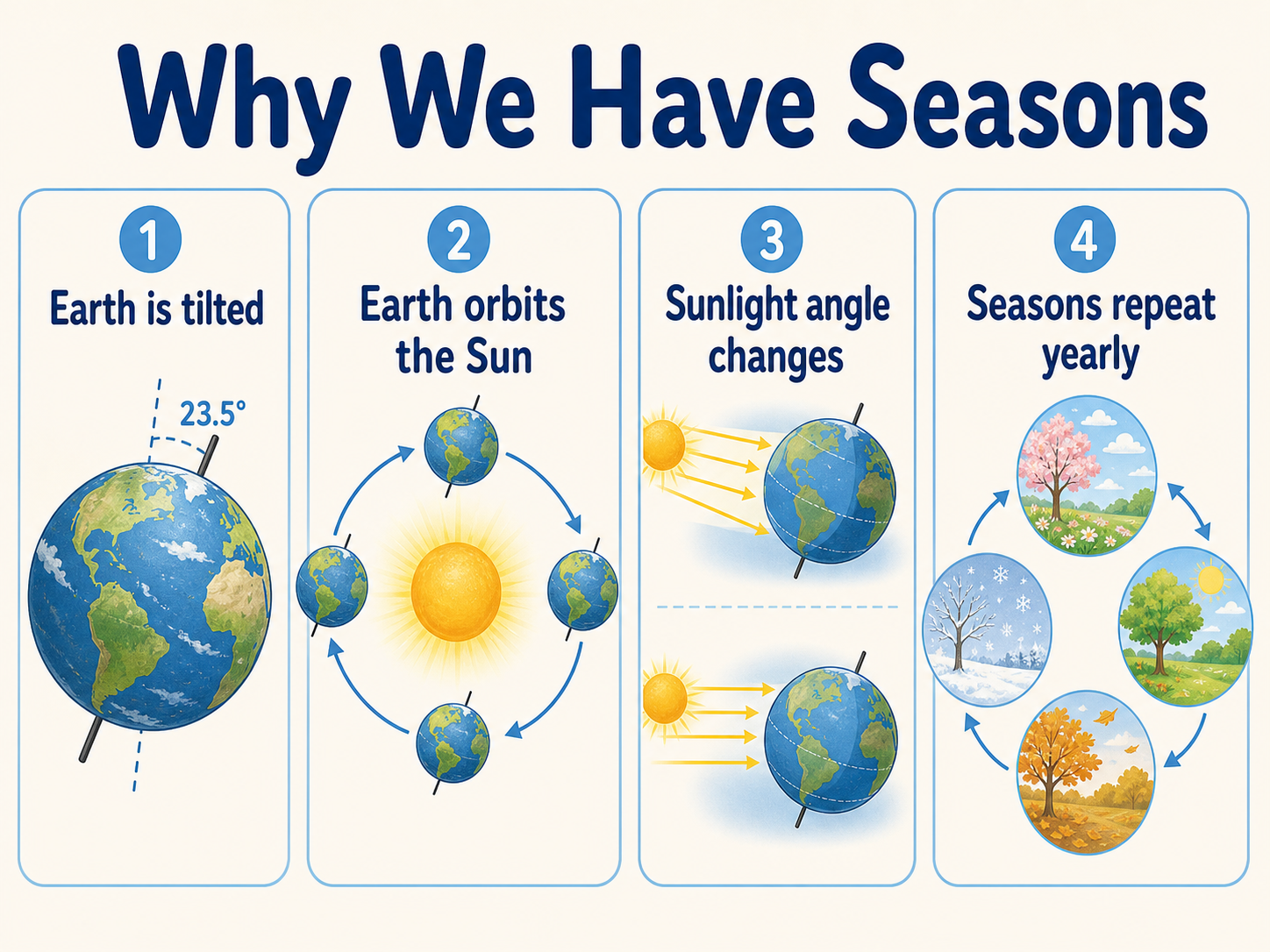
Many people think seasons happen because Earth moves closer to or farther from the Sun. But that is not the main reason. Seasons happen mostly because Earth is tilted.
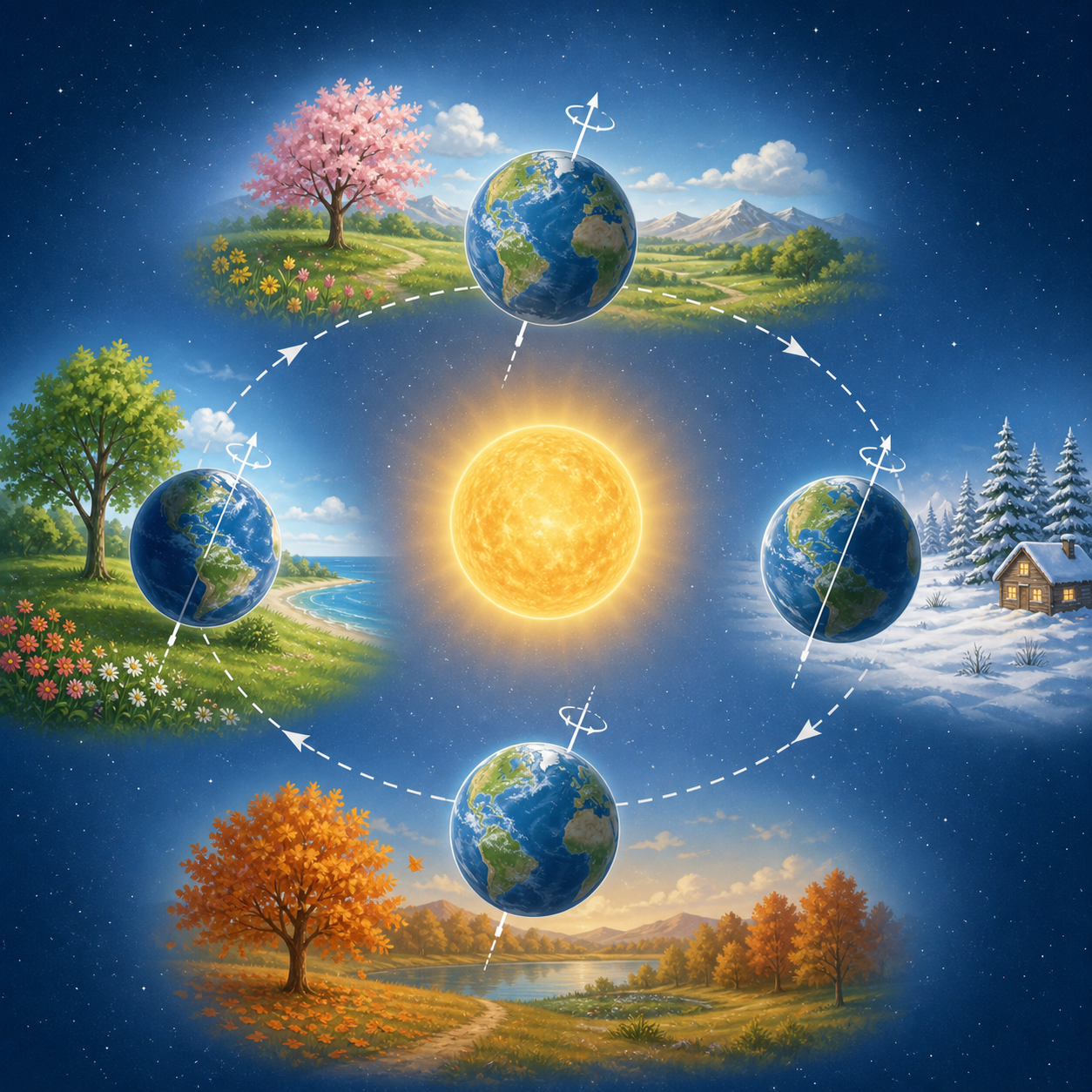
Earth spins around an imaginary line called an axis. This axis is not straight up and down. It is tilted. Because of this tilt, different parts of Earth get different amounts of sunlight during the year.
Earth also orbits the Sun. One orbit takes about one year. As Earth moves around the Sun, the tilted axis keeps pointing in almost the same direction.
When the Northern Hemisphere is tilted toward the Sun, it gets more direct sunlight and longer days. This makes summer. At the same time, the Southern Hemisphere is tilted away from the Sun, so it has winter.
Six months later, the situation changes. The Northern Hemisphere is tilted away from the Sun, so it gets less direct sunlight and shorter days. This makes winter there. The Southern Hemisphere has summer.
Spring and autumn happen between summer and winter. During these seasons, sunlight is more balanced between the two hemispheres.
The angle of sunlight is important. Direct sunlight feels stronger and warms the ground more. Slanted sunlight spreads out over a larger area, so it feels weaker.
Seasons are a result of Earth's tilt, its orbit, and changing sunlight. This simple pattern shapes weather, plants, animals, and human life around the world.
Key Vocabulary
| Word | Meaning | Example |
|---|---|---|
| season | one part of the year, such as spring or winter | Summer is the warmest season in many places. |
| axis | an imaginary line that a planet spins around | Earth spins around its axis. |
| orbit | to move around a planet, star, or object in space | Earth orbits the Sun. |
| hemisphere | half of Earth | The Northern Hemisphere has summer in June. |
| direct sunlight | sunlight that hits an area more straight on | Direct sunlight warms the ground more. |
Reading Comprehension Questions
- What is the main reason we have seasons?
- What is Earth's axis?
- How long does Earth take to orbit the Sun?
- What happens when the Northern Hemisphere is tilted toward the Sun?
- Why does direct sunlight feel stronger?
Answers
- We have seasons mostly because Earth is tilted.
- Earth's axis is an imaginary line that Earth spins around.
- Earth takes about one year to orbit the Sun.
- The Northern Hemisphere gets more direct sunlight and longer days, so it has summer.
- Direct sunlight warms the ground more because it hits an area more straight on.
Short Summary
Seasons happen because Earth is tilted as it orbits the Sun. Different parts of Earth receive different amounts and angles of sunlight during the year.
More Easy Readings
'Nature and Weather' 카테고리의 다른 글
| Why Do Clouds Turn Gray? | A2 ESL Science Reading Passage (0) | 2026.06.03 |
|---|---|
| What Makes Thunder? | A2 ESL Science Reading Passage (0) | 2026.05.27 |
| Why Do Leaves Change Color? | A2 ESL Science Reading Passage (0) | 2026.05.23 |
| Why Are Trees Important? | A2 ESL Science Reading Passage (0) | 2025.03.12 |
| What Is the Water Cycle? | A2 ESL Science Reading Passage (0) | 2025.03.11 |